

A breathless novel of World War I, a stylistic tour-de-force that blends such genres as allegory, magical realism and science fiction into a cohesive whole, told in a single sentence.
-The Pulitzer Prizes, on the winning work of the 2026 Pulitzer Prize in Fiction
I had not heard of Angel Down by Daniel Kraus before news broke that it had won the 2026 Pulitzer Prize in Fiction. Accompanying this news were a variety of opinions that it was a left-of-field, or weird, or wrong choice for the Prize. I obviously wanted to get in on this debate.
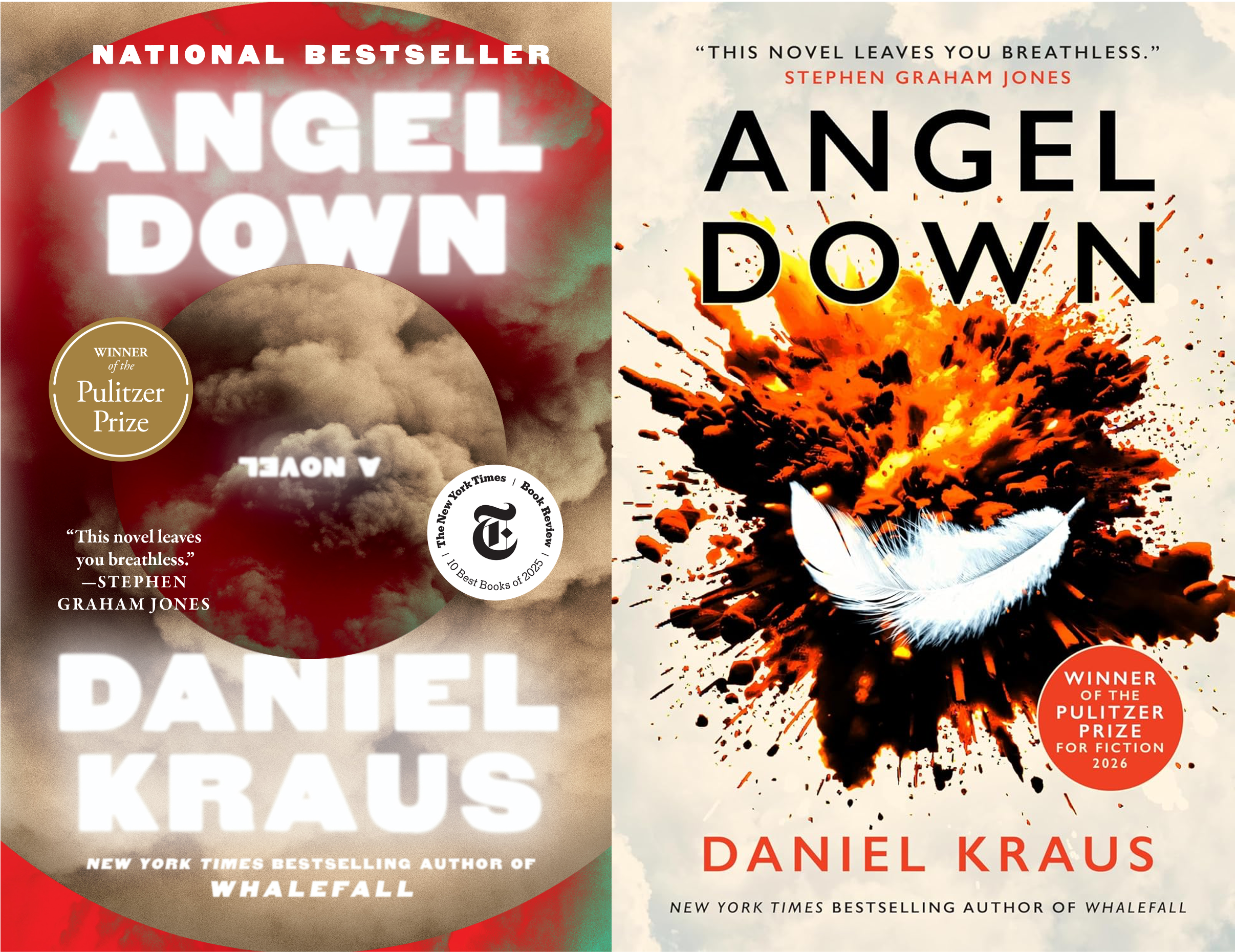
I do understand why this may seem like an odd choice for the Pulitzer from the outside. It is a war novel, genre fiction-adjacent, with a premise that does sound contrived - from the Goodreads description:
What they find amid the ruined battlefield, however, is not a man in need of mercy but a fallen angel…This celestial being may hold the key to ending the brutal conflict, but only if the soldiers can suppress their individual desires and work together.
What I found in Angel Down was not a contrived novel, but one with a unique style and confidence in what it wanted to deliver. The rhythm, structure and word choice made me want to keep reading. Meanwhile, the apparently rompy, adventure novel plot, delivered with little irony, sets up an expectation that conflict will be resolved, that the protagonist will be redeemed, that the angel fallen to Earth will fulfil its purpose. These expectations are subverted when this doesn’t happen at all. The nihilism of the ending sets Angel Down above the novel that it disguises itself to be.
This post does contain spoilers, but a greater caution is that it contains very gory language and descriptions of violence.
A single sentence
I am sure that part of Angel Down’s pitch was the fact that it does not contain a single complete sentence. This is not the first time a novel has used this gimmick - Booker-prize shortlisted Ducks, Newburyport mostly consists of a single sentence, while 2025 Nobel laureate Laszlo Krasznahorkai’s novel Herscht 07769 contains only a single period. Having peeked inside both of these other works while writing this, I can say that despite the lack of sentence breaks, Angel Down seems the easiest to read of the three because it is still (mostly) broken into short paragraphs, unlike the wall-to-wall text of the other two.
There is also a difference in that, while the other two examples are comprised of very long, but complete sentences, Angel Down begins with ‘and’ and ends with a comma - the sentence never actually ends. Kraus certainly plays with our expectation that the sentence will eventually end, but ultimately subverts it. The last few pages of the novel contain 55 repetitions of the word ‘and,’ building up suspense before the final line is read; ‘and Cyril Bagger considers himself lucky,’. If this sounds familiar, its because this is also the opening line of the novel. Here we see that the single-sentence format connects to the central idea conveyed in the novel; that despite our actions, the world will never change.
Far from making Angel Down difficult to read, I found that the never-ending sentence was very effective at keeping me engaged. It established a strong rhythm that made me want to continue reading, and it kept me wondering how and when the sentence was going to end. This combines with the language of the book to make a very hypnotic, engrossing novel.
A style that breaks all the rules
Angel Down’s never-ending sentence makes the reading experience one of inertia. But what really made me want to keep reading was the language. Kraus writes viscerally, evoking the horror of the front, and doesn’t hold back from describing gore and violence in vivid imagery. And it is near-constant; there are few moments where the writing is simple or not descriptive. This is textbook purple prose - so why is it so entertaining to read?
Take the below passage establishing the setting as an example:
and so Bagger sits up with vision aswirl and shoos away the filthy pelt of air, the pigeon-gray smoke and eyeball-white fog, and beyond the hills of diarrheal mud and the pappy craters from whence those hills were upchucked,
Almost every noun in this passage has an adjective, generally something that would be looked down upon as bad writing. But the claustrophobic level of description combined with the actual word choice does a great job of establishing setting. We can feel how thick and smoky the air would be through its description as a ‘filthy pelt’, and through the choice of the verb ‘shoos’. Vivid words of disgust (’filthy pelt’, ‘diarrheal mud’) are side-by-side with with more delicate, formal words and passive constructions (’vision aswirl’, ‘from whence those hills were upchucked’), setting a dissonant tone that mirrors the everyday horror of the front. From a rhythm perspective, ‘pigeon-gray smoke and eyeball-white fog’ is pleasant to read because of the pattern of four syllables with the same pattern of stressed and unstressed syllables; while word choice again makes the air feel thick and confining.
When depicting action, Kraus again avoids simplicity in favour of highly elaborate descriptions. For example;
‘Veck cannonballs helmet-first into the lummox’s kidney, Popkin ejecting brown batter,’
and
‘Reis lifts his lips to his nostrils, a disgusted inhale that siphons the lower half of his face into his sinuses’.
Both of these phrases describe some fairly simple actions, but use words that are incongruous with what is being described - i.e., they would normally be used to describe something else - like ‘brown batter’ to mean vomit, ‘siphons’ to describe a movement of the face. Using words that are out of place can risk the reader disconnecting from the idea being conveyed, but here they add to the tone and feeling in the text, and make the writing feel really fresh.
So why is reading this type of prose so satisfying when all writing advice suggests the contrary? I think the lack of sentence breaks means that in this case the flowery language creates flow. The highly stylised prose also plays well with the allegorical nature of the text.
Creating allegory
The plot of Angel Down is simple; the main character is sent on a quest to rescue an angel and bring her back to a figure of authority, requiring him to go on a journey. This is captured in the straightforward three-act structure; in Part I Bagger is given the quest, and finds the angel, in Part II he takes her from point A to point B, and in Part III he reaches his destination and completes his quest. This simple and predictable structure creates the frame on which to hang the allegory of the novel.
The central group of characters also play a role in setting up the allegory. Characters in an allegorical work often function as stand-ins for concepts or morals, and we see this in Angel Down. The five characters that start the journey to rescue the angel represent something, as is made pretty obvious in the following paragraph, where they are compared:
and each fellow goes about it different, Popkin’s drooly, lascivious stare, Veck hulking his arms like he’s protecting a baby, Arno mooning like he’d rather the angel carried him, while Goodspeed, by Bagger’s recollection, had carried the angel like she was a slot machine that would never quit paying out, all of which makes Bagger wonder how he holds the angel, all he’s certain of is that he knows her and she’s inspiring something inside him,
From this paragraph it is very clear that there are distinct motivations for each character; Popkin is motivated by sex, Veck by leaving a better world for his daughter, Arno by the mother he doesn’t have, Goodspeed by wealth. These motivations ultimately lead all four to their deaths (temporarily for Arno).
The motivations of Bagger are left for the reader to figure out, although there are some strong hints even in the first chapter of Part II. Bagger remembers his last conversation with his father:
“You’re looking for a purpose to save you!” he shouted, to which the Bishop, rather mournfully, replied, “Aren’t you?,”
If we situate this quote in the rest of the novel, we can see that this does describe what Bagger wants. Trapped in the nonsensical violence of the front, after living a life as a ‘useless dandy’, with the ‘shamefly’ hopping in his chest, what Bagger wants is to find purpose. This is what he sees in rescuing the angel, in protecting Arno, in delivering the angel to Reis so he can end the war. The novel is set up as a way for Bagger to find redemption for his unethical life prior to being drafted.
The contrast of Bagger with the four other characters in the above paragraph and in other points in the text positions him as essentially the chosen one. He begins to believe that he was destined to save the angel; that when she said, ‘I am the sword in the hand’, she meant his hand. This set up is then completely subverted in Angel Down’s finale.
The machine of war
The final climax of Angel Down sees the angel take Bagger to the centre of the Earth to be shown the machine of war that transforms bodies into bullets, death into more death. Unlike the others, this chapter has no paragraphs; it is wall-to-wall text, giving it the feeling of a climax. We experience the action as Bagger does; overwhelming, horrific, consuming, a cacophony of violence.
I’ve captured only a slice of this below, but the whole chapter is essentially like this. Bagger tracks the progress of ‘Earth’s murdered’ as they travel through this ‘infernal machine’, creating bullets to cause more death that feeds the machine in turn:
sixty thousand wheels, gears, blades, pulleys, pistons, and pumps in calamitous clatter, hot air shrieking from chimney whistles, soot coughing from behind the blistered teeth of metal grills, an intricate labyrinth of puffing, chugging, gasping, hacking machinery arranged around a flywheel cauldron into which the master root feeds, all of Earth’s murdered smelted into tar, scorching and bubbling but fanned by wheezing bellows of sheet metal before being sucked down the mazy throats of corroded pipes, each elbow so tenuously bolted it bleeds black lifeblood muck, a continuous draining action that powers a great windmill of threadbare cams and rotors reptiled with generations of spindrifted blood, and rolling from the firebrick of a throbbing, banging oven are tray after tray, chainmailed together, of human tar cooled to an ebony gelatin, knobby with bone, cartilage, and gristle, and with a factory honk and a puff of xanthous smoke, dozens of rusty guillotine blades drop in unison with the ungodly cymbal of overturned silverware drawers, dicing the inky jelly into thousands of patties of rubbery pulp,
The chapter is full of movement. There are lots of verbs ‘shrieking’, ‘puffing’, ‘throbbing, banging’ and again those vivid, disgusting images of ‘human tar’, ‘lifeblood muck’, ‘ebony gelatin’. This passage is about a fifth of the total length of the description of the machine - every step of the process is described with the same attention, impossible to stop reading.
Anachronistic images in this chapter conjure the prophetic nature of the allegorical style, including descriptions of hatreds ‘liked via glass screens yet to be invented but inside which we see our barbarity reflected’, and of ‘pilotless planes capable of murdering hundreds of people hundreds of miles from their emotionally disengaged operators’, and ‘artificial men instilled with artificial brains’. Victims of war are listed at length, extending beyond WWI, connecting the senseless violence of the book’s present with the senseless violence of the future by referring to contemporary conflicts:
how the dead announce themselves with off-stage shrieks, Iraqi, Turkish, Kurdish, Chinese, Ethiopian, Spanish, Japanese, Greek, Italian, Vietnamese, Pakistani, Indian, Colombian, Burmese, Korean, Algerian, Sudanese, Angolan, Filipino, Indonesian, Laotian, Cuban, Iranian, Sri Lankan, Somali, Rwandan, Bosnian, Burundi, Mexican, Nigerian, Syrian, Yemeni, Ukrainian, Israeli, Palestinian,
This climax occurs in the third-last chapter of the book - there is not far to go from here. The novel ends with Bagger’s realisation that the war only exists to feed the machine of death. What does this ending say about the novel we have just read?
On nihilism
The three-act structure described above sets up an expectation that Angel Down’s ending will offer a resolution or a redemption, that some change will occur. Ultimately though, there is no resolution. Angel Down ends with the realisation that none of the action of the book had any meaning. We start over at the beginning - literally, by repeating the first line of the novel.
In doing so, Kraus is exhibiting ideas that belong to the philosophical theory of nihilism. From the Internet Encyclopedia of Philosophy, ‘[e]xistential nihilism is the notion that life has no intrinsic meaning or value.’ In Angel Down, Bagger’s actions, purpose and role as the hero make no change to the world, and he is the same person at the end that he was at the start. Everything in which Bagger sought to find purpose is revealed to be meaningless. When the angel brings Arno back to life, he accepts the promise she suggests:
I will give you his life. In return, you must promise never to take another’s life for as long as you live. If you fail in this promise, a catastrophe beyond imagination will consume your entire world,
Upon seeing the machine, he realises that this vow, too, was meaningless: ‘though now he gets the joke, it wasn’t a vow but a condition that already exists’. Catastrophe will consume the world no matter Bagger’s actions.
The cruel joke continues when the angel’s true face is revealed. The being that Bagger protected is not an angel, not a flesh version of Solly Madonna from his father’s bible, not the sword in the hand. Instead:
the moon, peeking through grit, gleams off two obsidian horns that have grown from the angel’s head where the halo used to be,
and Bagger hears Father Muensterman’s curse, You’ll find the devil out there, Private Bagger!, maybe the old padre was right, though here at the end, here at the beginning, there’s no telling what’s an angel or a devil or if the two are the same,
Angel Down ends with the destruction of the line between angel and devil; with the last words becoming the first words; with the reasonless eternal consumption of life by the machine of death. But there is a note of hope. Bagger sees himself as an old man visiting France with his family in the future, and hears his future self say that despite the terrible knowledge he holds, he has no regrets. In response:
Private Bagger’s frail heart pounds back with force, and his bloodstream makes music, and he laughs, just once, but it’s the best laugh of his life, joyful surprise, and with it comes a tickle in his throat, inside his mouth, within the new gap in his teeth, and then the shamefly, good old Uncle Sam, comes buzzing out through the hole in his cheek and flies away, finally, finally away,
Despite his lack of purpose or redemption, Bagger’s shame and regrets, represented by the shamefly, finally leave him. I read this as a representation of existentialism as a response to nihilism; that despite the meaningless of existence, Bagger has determined his own meaning.
In summary
I could write a lot more about Angel Down. I was enthralled by its language, and the way it broke the rules. I loved the way it set up the character of Cyril Bagger, loved watching him climb up out of the mire, only to see all of the meaning he had found crushed like the bones in the infernal machine. I loved its humour, its unambiguousness, its intense imagery. Who knew a book about the endlessness of war could make me feel so excited about human creativity.
Read Beyond is about reading with intention. By thinking about how a book works, we can understand why we keep reading, and learn how to encourage our own readers to do the same. If you want to see more, subscribe for free.
If you want to say something about this book, want to recommend a books to explore, or have idea about how to make this publication better, leave a comment or send me a message.
Angel Down sounds very interesting, if not a little dark, from your perspective. Not sure how I would fare with no sentences!